Auto Repair Shop in Las Cruces Explains What Neglected Maintenance Really Costs
The True Cost of Deferred Vehicle Maintenance in Las Cruces
Skipping an oil change feels harmless when the car starts fine the next morning. So does putting off a brake inspection when the pedal still feels solid, or ignoring a faint engine knock that comes and goes. Most drivers in Las Cruces do not neglect their vehicles out of carelessness. They do it because deferred repairs rarely announce their consequences right away. By the time they do, what could have been a routine service visit has turned into a major auto repair.
Mango Automotive & Diesel has been serving Las Cruces and nearby areas since 2021, and the vehicles that come through our doors tell a consistent story. The repairs that hit hardest are rarely the result of a single event. They are the result of small services skipped over months, each one adding pressure to systems that were already working harder than they should in desert conditions. As a woman-owned auto repair shop in Las Cruces built around honest diagnostics and straightforward communication, we see the true cost of neglected vehicle care every week. Understanding that cost is the first step toward avoiding it.
What Deferred Vehicle Maintenance Actually Means
Skipping scheduled service does not always mean ignoring a loud noise or visible damage. More often, it means postponing tasks that do not feel urgent because the vehicle still runs.
Routine maintenance includes oil changes, brake inspections, tire rotations, fluid checks, filter replacements, and cooling system service. These are not optional extras. They are the scheduled interventions that prevent normal wear from becoming abnormal damage.
When these services are skipped or delayed, wear continues without correction. Components that were designed to be replaced on a schedule begin operating past their service life. Lubrication breaks down. Friction increases. Systems that depend on each other begin to fail in sequence.
A single neglected service rarely destroys a vehicle. But one deferred service makes the next problem more likely. Two deferred services accelerate the deterioration of a third. Over time, the vehicle that seemed fine because it still started every morning reaches a point where multiple systems fail close together. That is when drivers end up at a car repair shop facing bills that feel sudden but were actually months in the making.
Services That Create the Most Risk When Delayed
An overdue tire rotation rarely causes immediate damage. An overdue oil change can seize an engine within weeks. The difference between the two is not obvious from the driver's seat, which is why understanding which services carry real urgency matters more than simply staying on top of everything at once.
Engine Oil and Lubrication
Motor oil performs two jobs simultaneously. It lubricates metal components inside the engine to reduce friction, and it carries heat away from those components to prevent thermal damage. As oil ages, it loses viscosity (its ability to flow and coat surfaces properly), accumulates combustion debris, and breaks down under sustained heat.
When oil is not changed on schedule, internal engine parts begin operating with inadequate lubrication. Without that protective layer, moving components make direct contact inside an engine running at thousands of revolutions per minute. Sludge builds up inside the engine and blocks oil passages. The damage is cumulative, invisible from the outside, and expensive to correct once it reaches a critical point.
In Las Cruces, ambient temperatures above 100 degrees Fahrenheit accelerate oil degradation at a rate that drivers in cooler climates do not experience. The oil change interval that works in a moderate climate does not apply here. Extending intervals in this environment adds mechanical risk that does not exist elsewhere.
According to AAA, one in three U.S. drivers delays or skips recommended vehicle maintenance services. In a climate like Las Cruces, that delay carries a much higher consequence than the national average suggests.
Brake System Service
Skipping brake inspections allows worn components to reach failure before they are caught. The brake system depends on three components working together: brake pads (friction materials that press against rotating metal discs called rotors to slow the vehicle), brake fluid (a hydraulic fluid that transfers pedal pressure to the brake calipers), and the calipers themselves (the mechanical components that clamp the pads against the rotors). Each has a defined service life, and each degrades in a different way.
Brake pads wear down with every stop. Brake fluid absorbs moisture over time, which lowers its boiling point and reduces its ability to transmit hydraulic pressure reliably. Rotors develop grooves and thickness variations from repeated friction contact. When inspections are skipped, none of these changes are caught before they cause damage. Worn pads reach the metal backing plate. Rotors that could have been resurfaced require full replacement. Brake fluid with high moisture content can vapor-lock under heavy use, producing a soft or unresponsive pedal at the moment braking is most needed.
In Las Cruces, airborne dust works into brake assemblies and acts as a fine abrasive with every stop. Brake components wear faster here than in cleaner climates, meaning drivers who follow standard national service intervals may already be operating on brakes past their effective service life for this region.
Cooling System Maintenance
The cooling system regulates engine temperature by circulating coolant through the engine block and out through the radiator, where heat is released into the outside air. The system depends on functioning hoses, a working water pump, a properly opening thermostat, and clean coolant with its original anti-corrosion properties intact.
Neglecting cooling system service allows coolant to degrade, hoses to weaken internally, and the water pump to wear without detection. None of these changes produces obvious symptoms until the system reaches a failure point.
In Las Cruces, the cooling system operates under sustained stress for months at a time. Summer heat means the system rarely gets a break. A hose that is internally cracked but externally intact can rupture without warning when heat pushes coolant pressure to its peak. A thermostat that sticks closed causes the engine temperature to spike rapidly. Either failure can result in a full engine overheat, risking a warped cylinder head or a destroyed head gasket. At that point, the search for a mechanic shop near you becomes urgent rather than convenient, and the repair bill reflects the difference.
Wheel Alignment and Tire Rotation
Wheel alignment refers to the calibration of a vehicle's suspension geometry so that all four tires contact the road at the correct angle and in the correct relationship to each other. When alignment drifts out of specification, tires wear unevenly. The vehicle may pull to one side. Steering response changes. Suspension components experience stress that they were not designed to absorb.
Tire rotation, the practice of moving tires between wheel positions on a regular schedule, balances wear across all four tires rather than allowing the tires under the highest load to wear down first.
Both services are short, scheduled, and easy to defer because the vehicle feels drivable even when it is overdue. But uneven tire wear, once it is visible, means tires are already past the point where rotation would fully correct the problem. A vehicle with worn suspension components from chronic misalignment requires far more work to restore than a vehicle that received regular alignment checks.
In Las Cruces, road surface variation across the city and the added stress of summer heat on tire compounds make these services more relevant than in smoother, cooler environments.
How the Desert Climate Changes the Maintenance Equation
Las Cruces sits in one of the most demanding vehicle environments in the United States. Three specific conditions make deferred auto repair more consequential here than in most other cities.
Sustained High Heat
Vehicle manufacturers publish maintenance schedules based on average climate assumptions. Las Cruces does not operate under average conditions. Summer temperatures that stay above 100 degrees for weeks at a time place every rubber component, every fluid, and every electrical system under sustained thermal stress.
Rubber hoses, belts, and seals expand under heat and contract overnight as temperatures drop. Daily swings of 30 degrees or more between morning lows and afternoon highs repeat this cycle hundreds of times per year. The material fatigue this creates is not visible from outside the component. Belts that look intact can have internal cracking. Seals that appear fine can be on the edge of failure.
Dust and Airborne Particulates
The Chihuahuan Desert generates consistent fine dust that enters vehicle systems through every available opening. Engine air filters clog faster here than in other regions. Cabin air filters, which remove particulates before air reaches the passenger compartment and the A/C evaporator, require replacement more often than standard manufacturer intervals suggest.
Dust that enters brake assemblies acts as an abrasive at the point of friction contact. Dust that accumulates on radiator fins reduces the radiator's ability to release heat into the outside air. Neither effect is dramatic on its own. Combined with already-stressed components from the heat, they move vehicles toward failure faster than drivers in other climates would expect.
Sequential Failure
Desert heat and dust do not typically cause a single catastrophic failure. They cause multiple systems to degrade at roughly the same time. A vehicle that is overdue for an oil change, has worn brake pads, and has degraded coolant is operating with three concurrent vulnerabilities. Any one of them can trigger a failure that stresses the others.
This is the pattern that surprises many drivers. The vehicle seemed fine for months, and then several things went wrong at once. What felt sudden was actually a sequential degradation that had been building across multiple systems. A routine inspection at a mechanic shop near you can catch that progression early, before one vulnerability triggers the next.
Warning Signs That a Vehicle Needs Service
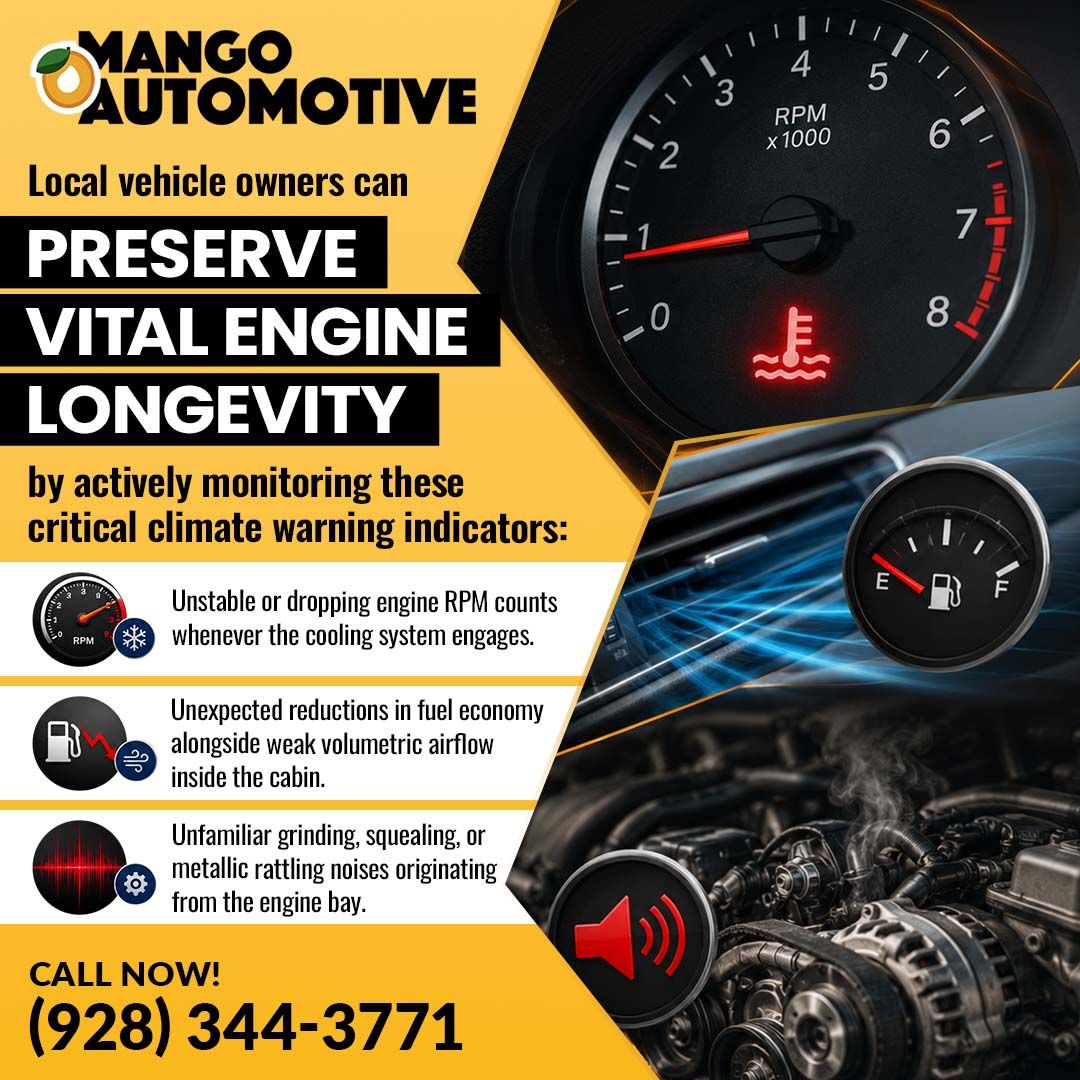
A vehicle communicates developing problems before those problems become failures. Recognizing these signals early is the most practical way to stay ahead of unplanned repairs before they escalate into a visit to a car repair shop under emergency circumstances.
Sounds That Indicate Wear
Unusual noises during driving are often the earliest sign that a component needs attention.
- Grinding or squealing when braking indicates brake pad wear.
- Knocking or tapping from the engine points to lubrication issues or bearing wear.
- Squealing from the engine bay at startup often indicates a worn or loose serpentine belt (the belt that drives the alternator, water pump, and A/C compressor).
- Rattling from underneath the vehicle may point to loose exhaust components or worn suspension parts.
Physical Sensations During Driving
Changes in how a vehicle handles or responds are reliable indicators of mechanical wear.
- A steering wheel that vibrates at highway speed suggests tire imbalance or rotor wear.
- A vehicle that pulls to one side while braking or driving straight indicates uneven brake wear or alignment issues.
- A brake pedal that feels soft or requires more travel than usual suggests brake fluid moisture contamination.
- Sluggish acceleration or rough gear transitions can indicate transmission or fuel system wear.
Visual and Sensory Indicators
What a driver sees and smells can reveal developing problems that are not yet audible or physical.
- Fluid spots under a parked vehicle.
- Cracks visible in belts or hoses.
- Active dashboard warning lights.
- Smoke from under the hood.
- A burning oil smell while driving.
- A sweet smell near the engine compartment, typically indicating a coolant leak.
- A musty odor from the vents, often indicating mold growth in the A/C evaporator.
Any one of these indicators is a reason to schedule a visit to a trusted mechanic shop near you before the symptom progresses further.
A Practical Maintenance Schedule for Las Cruces Drivers
Las Cruces qualifies as a severe duty climate by most manufacturer definitions. Sustained heat, persistent dust, and frequent short trips all place vehicles under conditions that wear components faster than schedules built for moderate climates account for. The intervals below reflect what vehicles in this region actually need.
- Engine oil: Every 3,000 to 5,000 miles for conventional oil; every 7,500 miles for full synthetic
- Brake inspection: Every 12,000 miles or once per year, whichever comes first
- Tire rotation: Every 5,000 to 7,500 miles
- Alignment check: Once per year or when symptoms appear, such as the vehicle pulling to one side or uneven tire wear becoming visible
- Cooling system inspection and fluid check: Every 30,000 miles or every two years, depending on coolant type and vehicle age
- Cabin and engine air filters: Every 12,000 to 15,000 miles in desert conditions
Vehicles used for towing, rideshare driving, or extended highway use may need more frequent attention across most of these intervals. When in doubt, a diagnostic inspection at a qualified car repair shop identifies what needs attention before a problem develops into a failure. Scheduling that inspection at a trusted auto repair shop in Las Cruces takes less time than most drivers expect.
Vehicle Care in Las Cruces, Done Right at Mango Automotive & Diesel
Mango Automotive & Diesel provides scheduled maintenance and full-service auto repairs for all makes and models across Las Cruces and nearby areas. Our technicians are familiar with the specific failure patterns common to desert vehicles, from dust-contaminated brake assemblies to heat-degraded cooling components and oil that degrades faster than standard intervals account for.
At Mango Automotive & Diesel, every vehicle receives a thorough inspection before any work is approved. We explain what we find, walk through the recommended service, and get approval before anything is touched. No surprises, no unnecessary repairs.
Every qualifying repair at Mango Automotive & Diesel is backed by a 60-month/60,000-mile warranty, including 36 months/36,000 miles of nationwide coverage and an additional 24 months/24,000 miles at our Las Cruces location. Exclusions apply.
Book Your Next Service Appointment in Las Cruces
If your vehicle is overdue for maintenance or you have noticed any of the warning signs described above, do not wait for the problem to develop further.
Call Mango Automotive & Diesel at (575) 221-9941 to schedule your service today. Our team is ready to inspect your vehicle, identify what needs attention, and get you back on the road with confidence.