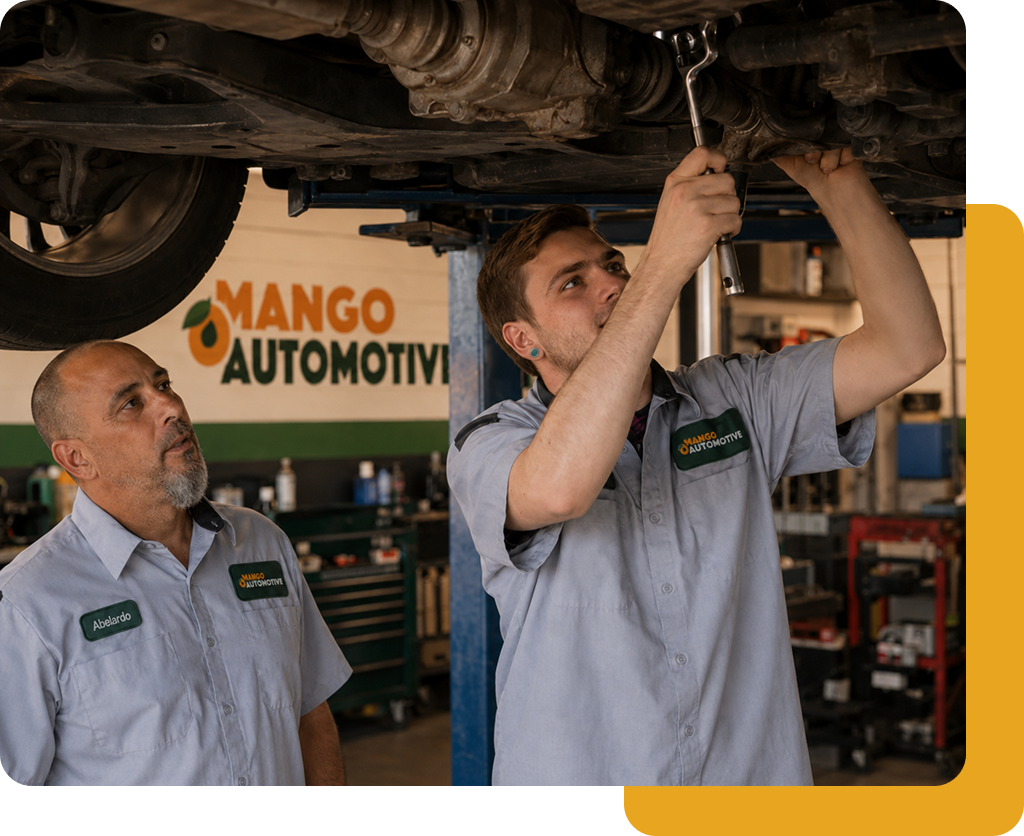
How AWD and 4WD Problems Affect Vehicle Handling: Insights from Certified Mechanics in Albuquerque
All-wheel drive (AWD) and four-wheel drive (4WD) systems are built to distribute engine power across all four wheels. This improves traction, stability, and control across a range of road conditions. When these systems develop problems, the effects appear directly in how your vehicle handles, often starting subtly and worsening over time.
A failing AWD or 4WD system reduces your vehicle's ability to maintain traction, steer accurately, and respond predictably to driver inputs. At
Mango Automotive, our team diagnoses drivetrain faults early, before minor issues develop into major repairs that take your vehicle off the road longer than necessary. Bringing your vehicle to a
certified mechanic in Albuquerque at the first sign of a handling change is the most reliable way to protect your drivetrain and avoid extended downtime.

AWD and 4WD: How Each System Works
Understanding the difference between AWD and 4WD systems helps clarify why failures affect vehicles in different ways.
AWD (All-Wheel Drive) operates automatically and continuously. It uses sensors and a computer-controlled transfer case(the central unit that splits engine torque between the front and rear axles) to send power to the wheels with the most traction. Drivers do not activate AWD manually. It is common in crossovers, sedans, and everyday SUVs.
4WD (Four-Wheel Drive) is a driver-activated system. The driver engages it using a lever or electronic switch when road conditions call for it, such as deep mud, sand, or snow. 4WD locks power to both axles at a fixed ratio, making it better suited for off-road use. It is standard on most trucks and body-on-frame SUVs.
Both systems share key components: the transfer case, front and rear differentials (components that allow each wheel on an axle to turn independently when cornering), driveshafts, CV joints (constant-velocity joints that transmit torque while allowing for suspension movement), wheel speed sensors, and electronic control modules. A failure in any one of these components affects the entire system's ability to manage vehicle handling.
How AWD and 4WD Failures Affect Vehicle Handling
Drivetrain problems do not always announce themselves immediately. Many handling changes develop gradually, which is why drivers sometimes attribute them to tire wear or road conditions rather than a drivetrain fault.
Reduced Traction and Road Grip
A malfunctioning AWD or 4WD system stops distributing power correctly, leaving certain wheels without adequate drive force and reducing overall traction.
For example, a 4WD truck with a failed front hub actuator (the part responsible for connecting the front wheels to the drivetrain) will not deliver power to those wheels even when the driver switches into 4WD mode. From the driver's seat, everything looks normal, but the vehicle has lost half its traction capability without any clear warning.
On an AWD crossover, a failed clutch pack or solenoid inside the rear differential module may stop rear wheel engagement entirely. The vehicle then operates on front-wheel drive only, with reduced stability during acceleration and cornering.
Vehicle Pulling and Steering Drift
Uneven power distribution between the left and right wheels causes the vehicle to pull to one side, affecting straight-line tracking and cornering behavior.
The differential allows wheels on the same axle to spin at different speeds during turns. When a differential wears out or loses lubrication, it may distribute torque unevenly, creating a pull that is often mistaken for a wheel alignment problem.
This is why getting both the wheel alignment and the drivetrain checked at the same time matters. A
mechanic shop near you can identify whether the pull is coming from an alignment issue, a drivetrain fault, or both, rather than treating one without ruling out the other.
Driveline Vibration and Shuddering
Vibrations during acceleration or cornering point to worn CV joints, imbalanced driveshafts, or failing wheel bearings, all of which create mechanical imbalance in the drivetrain.
For example, a worn CV joint produces a clicking sound during turns before progressing to a shudder felt through the seat and steering wheel. A damaged driveshaft can cause a rhythmic vibration that increases with vehicle speed. Ignoring these vibrations puts added stress on nearby components like U-joints, which connect the sections of the driveshaft, and output shaft bearings, shortening the lifespan of parts that are costly to replace.
Driveline Binding in Turns
Driveline binding occurs when an AWD system stays engaged during normal on-pavement driving, creating resistance, jerking, or bucking during tight turns.
This happens because all four wheels travel different distances during a turn. The outer wheels cover more ground than the inner wheels. When the system locks both axles at the same rotation speed, the drivetrain works against itself through the turn. This condition puts direct stress on the transfer case, differentials, CV axles, and tires.
It is particularly common when a 4WD system is left engaged on dry pavement in low range, or when an AWD coupling fails in a stuck-engaged position.
Uneven and Accelerated Tire Wear
Drivetrain faults that cause uneven torque distribution lead to uneven tire wear, typically more pronounced on the front axle, where steering and braking forces are already concentrated.
On AWD vehicles, mismatched tires are also a contributing factor. Because AWD computers monitor wheel speed differences to detect traction loss, tires with even slightly different tread depths can confuse the system and trigger unnecessary power transfers. Tire replacements on AWD vehicles are generally done in matched sets of four for this reason. A mechanic can measure tread depth across all four tires and advise on whether a full set is needed.
Warning Signs Drivers Should Recognize
Identifying drivetrain problems early reduces the extent of repairs needed and prevents handling from deteriorating to an unsafe level.
Dashboard Warning Lights
A steady or flashing warning light indicates the system has detected a fault. The most common causes include an electronic sensor failure, a control module issue, or a mechanical fault within the transfer case. A flashing light signals that the system needs immediate inspection. Continued driving with an active drivetrain fault can escalate into gear binding, overheating, or full system failure.
AWD vehicles display an "AWD Fault" or traction control warning on the dashboard. Because AWD operates automatically, drivers often have no other immediate indication that the system has stopped functioning correctly until handling is already affected.
4WD vehicles display a 4WD indicator light that may flash, stay lit without confirmation of engagement, or fail to illuminate when the system is switched on. Either condition signals a fault that warrants professional inspection.
Unusual Drivetrain Noises
Grinding noises during acceleration or turns point to worn transfer case gears or differential components. Whining noises typically indicate bearing failure inside the differential or transfer case. Clicking sounds, especially during slow turns, are a common indicator of a worn CV joint. Each of these sounds reflects a specific mechanical issue. Taking your vehicle to a mechanic shop near you for evaluation as soon as these sounds appear prevents further damage to connected components.
Both AWD and 4WD vehicles produce these same noise patterns when drivetrain components wear. The difference is that 4WD trucks and SUVs used for towing or off-road driving tend to develop transfer case and differential noise earlier due to higher operating stress on those components.
4WD Engagement and Disengagement Problems
This warning sign applies specifically to 4WD systems. AWD engages and disengages automatically, so drivers of AWD vehicles will not experience manual engagement failures.
When a 4WD system refuses to engage, stays stuck in a drive mode, or shifts inconsistently between high and low range, the cause is typically a vacuum actuator failure, a damaged shift fork, or an electrical sensor malfunction. A system stuck in 4WD Low (a setting meant only for extreme off-road conditions) places extreme stress on the transfer case, differentials, and tires on dry pavement while also increasing fuel consumption.
AWD System Hesitation and Inconsistent Response
This pattern is more specific to AWD vehicles. Because AWD operates automatically through electronic sensors and clutch packs, a partially failing system may perform reliably on some occasions and fail unexpectedly on others. Drivers may notice the vehicle handling normally under light conditions, but losing stability suddenly during hard acceleration, wet roads, or sharp cornering, which are the exact situations that demand full AWD response.
This intermittent behavior often points to a failing AWD coupling, a worn clutch pack, or a sensor reading inconsistently. A mechanic shop near you with AWD diagnostic capability can replicate the condition and identify the specific fault.
Changes in Fuel Efficiency
A drivetrain system that is struggling due to binding, fluid breakdown, or mechanical wear forces the engine to work harder than it should. A noticeable drop in fuel economy without a change in driving habits can be a drivetrain signal worth investigating, not just an engine issue.
AWD vehicles tend to show this symptom when an AWD coupling is stuck engaged, forcing continuous four-wheel power transfer even on dry pavement where it is not needed. 4WD vehicles show it most commonly when the system is accidentally left in 4WD High or Low on paved roads.
Whether your vehicle runs on AWD or 4WD, a certified mechanic in Albuquerque can diagnose each of these warning signs accurately and make sure the right repair is done the first time.
Common Causes of AWD and 4WD System Failures
The majority of AWD and 4WD failures trace back to deferred maintenance, fluid breakdown, or electronic sensor faults. Knowing the root causes helps drivers take the right preventive steps.
Low or Contaminated Drivetrain Fluid
The transfer case and differentials require clean gear oil to lubricate moving parts and dissipate heat. When fluid breaks down or drops below the required level, metal-on-metal contact begins, leading to gear scoring, bearing damage, and component failure. 4WD vehicles used for towing or off-road driving contaminate fluid faster and require more frequent service intervals. AWD vehicles follow standard manufacturer intervals but are not exempt, as fluid breakdown occurs with age and mileage regardless of use type.
Worn CV Joints and Protective Boots
CV joints are sealed inside rubber boots that retain grease and keep out road contaminants. When a boot cracks or tears, the joint wears rapidly, progressing from clicking sounds to shuddering to complete failure. AWD vehicles tend to see more front axle CV joint wear due to continuous load, while 4WD trucks are more prone to rear CV axle wear from repeated low-range off-road use.
Sensor and Control Module Failures
A single faulty wheel speed sensor can trigger false traction events, cause erratic AWD engagement, or disable the system entirely. These faults are accurately diagnosed only with professional scan equipment, not basic OBD-II readers. This cause applies more directly to AWD vehicles, though electronic shift control failures do occur in modern electronically controlled 4WD trucks.
Transfer Case Wear
Leaking seals, worn gears, and failing actuators are the most common transfer case failure points. When left unresolved, transfer case faults lead to driveshaft misalignment, added stress on U-joints and output bearings, and vibrations throughout the drivetrain. 4WD vehicles experience this earlier from mechanical overload, while AWD vehicles develop it gradually through fluid breakdown.
Routine Maintenance for AWD and 4WD Vehicles
Routine maintenance is the most reliable way to extend the service life of AWD and 4WD components and keep handling predictable. Partnering with the best mechanics in The Heights gives you a maintenance plan tailored to your vehicle's make, model, and driving conditions.
Transfer Case and Differential Fluid Service
Transfer case and differential fluid should be serviced at regular intervals, typically every 30,000 to 60,000 miles under normal driving conditions. Contaminated fluid is one of the leading causes of premature bearing and gear wear. 4WD vehicles used for towing or off-road driving require shorter service intervals due to faster fluid breakdown. AWD vehicles follow standard manufacturer intervals, but should not delay service past the recommended mileage.
CV Joint and Boot Inspection
CV boots should be inspected at every service visit. A cracked or torn boot allows grease to escape and contaminants to enter the joint, accelerating wear and eventually leading to CV joint failure. AWD vehicles benefit from more frequent front axle CV inspection, given the continuous load those joints carry during normal driving.
Tire Rotation and Matching
Tires on AWD vehicles should be replaced in matched sets of four. Tread depth differences across the four tires can affect AWD sensor readings and trigger unwanted system behavior. For 4WD vehicles, mismatched tires are less likely to confuse the system when 4WD is disengaged, but they still affect handling. A mechanic can assess tread depth across all positions and advise on the right rotation schedule for your vehicle.
Annual Drivetrain Inspection
An annual drivetrain inspection covers driveshafts, U-joints, differential seals, transfer case mounts, and sensor integrity, identifying wear before it affects handling or safety. For 4WD vehicles used off-road or for towing, an inspection every six months is more appropriate. For AWD vehicles driven primarily on paved roads, an annual inspection aligned with other major service visits is sufficient to catch developing issues in time.
AWD and 4WD Repair at Mango Automotive in Albuquerque
AWD and 4WD repairs require professional diagnostic tools, manufacturer-specific technical data, and hands-on test drive evaluation. Reading a warning code is only the first step. Accurate diagnosis requires understanding how each component within the drivetrain system interacts and which failure is producing a given set of symptoms.
A certified mechanic in Albuquerque with AWD and 4WD diagnostic experience can identify the root cause accurately, rather than replacing parts without a confirmed diagnosis. At Mango Automotive, our technicians are trained to work on a wide range of domestic and foreign vehicles, from trucks and body-on-frame SUVs to crossovers and hybrid AWD platforms. Our approach is built on honest communication, transparent pricing, and quality workmanship at every visit.
From transfer case fluid service and CV joint inspection to full drivetrain diagnostics and component replacement, Mango Automotive covers the complete range of AWD and 4WD repair needs. Every service is handled by certified technicians using professional diagnostic equipment, so repairs are based on accurate diagnosis rather than guesswork.
Mango Automotive also provides a full range of automotive services beyond drivetrain repairs, including A/C service, brake and suspension work, alignments, and routine maintenance. Every vehicle that comes through our doors receives the same level of attention, whether it is in for a routine service or a complex AWD or 4WD repair.

This is paragraph text. Click it or hit the Manage Text button to change the font, color, size, format, and more. To set up site-wide paragraph and title styles, go to Site Theme.


Cooling System Checks Before Arizona Road Trips: What to Expect from an Auto Repair Shop in Yuma, AZ