Diesel Repair in Las Cruces: How Heat Breaks Down Radiators and Cooling Components
Diesel engines generate more combustion heat than gasoline engines due to their higher compression ratios. Those same ratios that give diesel vehicles their power and torque place continuous thermal demand on the cooling system with every drive. When cooling components begin to wear down, the engine is at risk of overheating, one of the most damaging mechanical failures a diesel vehicle can experience.
Truck owners and fleet operators across Las Cruces know that a diesel engine is only as dependable as the systems that support it. At
Mango Automotive & Diesel, our team has built a reputation for helping drivers stay ahead of the failures that come from deferred maintenance. Through years of hands-on
diesel repair experience, we have seen cooling system neglect take engines from a minor service need to a full breakdown. This guide walks through how heat affects each major cooling component, what symptoms deserve immediate attention, and how staying ahead of wear protects the engine long term.

Diesel Engine Cooling System
The cooling system moves heat away from the engine block and cylinder head by circulating coolant through a continuous loop between the engine and the radiator.
Coolant, also called antifreeze, absorbs heat from internal engine components, travels to the radiator, where that heat is released into the air, and then returns to the engine to repeat the cycle. Six components work together to keep this process running:
- Radiator - A heat exchanger that draws heat out of the coolant and releases it into the outside air.
- Water pump - Drives coolant circulation through the engine and radiator.
- Thermostat - A heat-sensitive valve that regulates how much coolant flows to the radiator.
- Radiator hoses - Upper and lower hoses that route coolant between the engine and radiator.
- Cooling fan - Draws air through the radiator fins when the vehicle is moving slowly or at idle.
- Coolant - The fluid that circulates through the engine and carries heat away from internal components.
These components are interdependent. When one degrades, the others absorb the added workload, and overall system wear accelerates.
Heat Damage Across Cooling System Components
Diesel engines place continuous thermal stress on every part of the cooling system. The radiator, hoses, thermostat, water pump, and cooling fan each respond to that stress in different ways. Understanding where failure starts helps identify problems before they reach the engine itself.
Radiator
Heat, corrosion, and debris reduce a radiator's ability to transfer heat over time, forcing the engine to operate at higher temperatures.
The radiator handles extreme thermal cycles every time the engine runs. Internally, degraded coolant leaves behind scale, rust, and sludge that narrow the radiator's passages and restrict coolant flow. Externally, dirt, road debris, and insects pack into the fins and block the airflow needed for heat exchange.
A radiator working at reduced capacity passes that burden to the rest of the cooling system. The thermostat, water pump, and hoses all work harder to compensate, which shortens their service life.
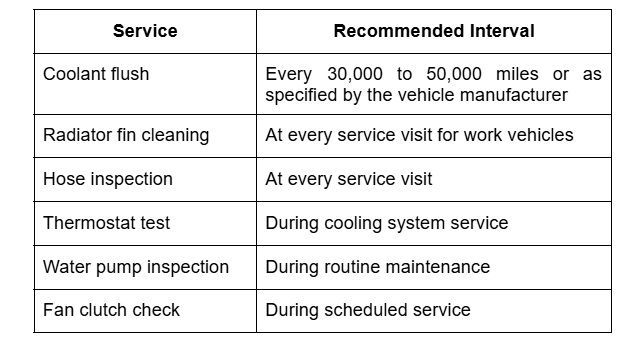
Most manufacturers recommend a coolant flush every 30,000 to 50,000 miles. Keeping the exterior fins clear of debris is equally important for vehicles that operate in demanding environments.
Radiator Hoses
Radiator hoses degrade under sustained heat and pressure, often developing internal damage before any visible external symptoms appear.
The upper radiator hose routes heated coolant from the engine toward the radiator, where that heat is released into the air. The lower hose returns cooled coolant back to the water pump. Both hoses operate under constant pressure and experience large temperature swings throughout the day.
Over time, the rubber compound hardens, cracks, or softens in ways that are not always detectable from the outside. A hose that looks intact may already be compromised internally. When a hose collapses or develops a leak, coolant flow is disrupted, and engine temperatures rise rapidly.
Visible warning signs include swelling, soft spots, or surface cracking along the hose body, coolant staining near clamps and fittings, white steam or a sweet smell from under the hood, and a temperature gauge reading higher than its normal range.
Hose inspection should be part of every routine service visit. A hose replacement is a straightforward service. The cylinder head damage that can result from the overheating caused by a failed hose is not.
Thermostat
A thermostat that fails due to heat or age prevents the engine from regulating its own temperature, leading to overheating or chronic underperformance.
The thermostat sits at the engine coolant outlet and acts as a gatekeeper for coolant flow. When the engine has not yet reached operating temperature, the thermostat stays closed, restricting coolant flow to the radiator until the engine is properly warmed up. Once the engine reaches operating temperature, the thermostat opens to allow full coolant circulation through the radiator.
A thermostat stuck in the closed position cannot open, so coolant cannot reach the radiator, and engine temperature climbs quickly. A reliable indicator of this condition is a hot upper radiator hose combined with a cold lower hose, which confirms that coolant is not circulating through the radiator.
A thermostat stuck in the open position keeps the engine from ever reaching its correct operating temperature. This reduces combustion efficiency, increases fuel consumption, and raises exhaust emissions.
A diesel mechanic can test thermostat function using scan tools and infrared thermometers. Replacing a failing thermostat during a scheduled service visit prevents the more involved repairs that result from the overheating it causes.
Water Pump
A water pump that loses flow capacity due to internal wear allows coolant to stagnate inside the engine, creating hot spots that lead to component damage.
Inside the water pump is an impeller, a spinning component that generates the pressure needed to push coolant through the engine block, cylinder head, and radiator. Corrosion from degraded coolant erodes the impeller over time, reducing how much coolant it moves with each rotation.
When the water pump no longer circulates adequate coolant volume, the engine develops hot spots even when the coolant reservoir appears full. The fluid level looks normal, but the flow rate is not sufficient to manage engine heat. This is a frequent source of misdiagnosis.
Signs of water pump wear include coolant leaking near the front of the engine, a grinding or whining noise from the pump area, engine temperature rising despite a normal coolant level, and milky or discolored oil indicating internal seal failure.
Water pump wear develops gradually and does not always produce obvious symptoms until the pump is close to failure. Scheduling routine maintenance with a diesel mechanic near you is the most reliable way to catch impeller wear, seal degradation, and early leaks before they result in an unplanned breakdown on the road.
Cooling Fan and Fan Clutch
A failing cooling fan or fan clutch removes the system's ability to shed heat during low-speed driving and idle, causing overheating when airflow through the grille is minimal. At highway speeds, forward motion pushes air through the radiator naturally. At low speeds and idle, the cooling fan handles that function. The fan clutch is a coupling device that engages the fan based on engine temperature.
When the fan clutch fails, the fan spins too slowly or does not activate at all. A common pattern is an engine that holds normal temperature on the highway but climbs toward the red zone while idling in traffic or on a job site. That pattern points directly to a fan clutch problem.
Electric fans, standard on many newer diesel vehicles, can fail due to electrical faults with similar results. In either case, the radiator cannot dissipate heat when natural airflow is not present.
Heat does not affect one component at a time. The entire cooling system absorbs thermal stress on every drive, and failure in any one part puts the others at greater risk. Skilled diesel mechanics in Las Cruces, like Mango Automotive & Diesel, are equipped to assess the cooling system as a whole, giving drivers and fleet operators an accurate picture of where things stand before a minor issue turns into a breakdown.
Consequences of Cooling System Failure
Overheating creates a progression that can affect the cylinder head, head gasket, engine block, and beyond. Understanding what overheating produces makes it clear why cooling system maintenance is not optional for diesel vehicles, and why catching problems early with a diesel mechanic near you matters more than most drivers realize.
- Warped cylinder heads: Extreme heat causes metal to expand and distort, breaking the seal between the cylinder head and engine block. The result is compression loss and internal coolant or oil leaks.
- Blown head gaskets: A head gasket is a sealing component positioned between the cylinder head and the engine block. When overheating drives pressure beyond the gasket's design limits, it fails. Coolant and oil mix internally, and white smoke appears from the exhaust.
- Cracked engine block: Sustained or repeated overheating creates thermal stress fractures in the engine block. This is one of the most involved repairs a diesel vehicle can require.
- Seized engine: In severe cases, metal components expand to the point where they can no longer move, requiring full engine replacement.
Each of these outcomes traces back to a cooling system that was not serviced while the problem was still manageable.
Cooling System Maintenance Intervals
Routine maintenance keeps cooling system components functioning as designed and interrupts the progression from minor wear to major failure. Following the manufacturer's recommended service intervals is the most straightforward way to stay ahead of wear before it affects engine performance.
Coolant quality deserves the same attention as coolant level. Old coolant becomes acidic and loses its ability to prevent internal corrosion. A flush performed by a qualified diesel mechanic removes degraded fluid along with the deposits it leaves inside radiator passages and the engine block.
Using the correct coolant type matters as well. Mixing incompatible coolant formulations produces gel-like deposits that can block narrow radiator passages and restrict flow through the oil cooler, an avoidable situation that often results in unnecessary diesel repair down the road.
Warning Signs That Need Prompt Attention
Changes in engine temperature or the presence of coolant-related symptoms are indicators that a diesel mechanic near you should inspect the cooling system. Drivers should treat these as reasons to schedule service:
- Temperature gauge reading above its normal operating range.
- Coolant warning light on the dashboard.
- Sweet-smelling steam from under the hood.
- White smoke from the exhaust during operation.
- Coolant pooling under the vehicle after it has been parked.
- Coolant level dropping without a visible external leak.
These symptoms do not clear up on their own. Every mile driven with a degraded cooling system increases the risk of damage that extends well past the cooling system itself.
Mango Automotive & Diesel: Diesel Cooling System Service in Las Cruces
Mango Automotive & Diesel provides cooling system inspections, diagnostics, and repair for diesel vehicles throughout Las Cruces and nearby areas in New Mexico.
Full-System Inspection Approach
Our diesel mechanics in Las Cruces inspect the full cooling system rather than only the part showing a symptom. A leaking hose, for example, may point to extended low coolant levels that have been stressing the thermostat and water pump for some time. Addressing the visible issue without checking connected components leaves the underlying cause in place.
Transparent Diagnostics and Service
We use diagnostic equipment to test real-time coolant temperature, evaluate system pressure, assess coolant condition, and read fault codes tied to cooling system performance. Every finding is communicated clearly before any repair is recommended. No hidden fees and no unnecessary work.
Reliable Service for Every Diesel Vehicle
From light-duty pickups to commercial fleet vehicles, Mango Automotive & Diesel delivers consistent, reliable cooling system service across Las Cruces and nearby areas in New Mexico. Every vehicle that comes through our doors receives a thorough inspection, clear communication, and repair work backed by a team that takes long-term engine health seriously.

Schedule Your Cooling System Inspection
If your diesel vehicle is overdue for a coolant flush, is showing any of the symptoms above, or has not had its cooling system checked recently, call Mango Automotive & Diesel at (575) 221-9941 to book an appointment. Our diesel mechanics in Las Cruces serve drivers and fleet operators throughout the area and surrounding communities across New Mexico.