EV Cooling System Maintenance: Insights From Certified Mechanics in Albuquerque
If you drive an electric vehicle in Albuquerque, summer heat is one of the biggest threats to your battery's health. Temperatures in The Heights and across the city regularly climb past 90°F, with afternoon highs exceeding 100°F from late spring through September. That kind of sustained heat puts real stress on your EV's cooling system, the component responsible for keeping your battery at a safe operating temperature. When that system starts to fail, the effects show up as reduced range, slower charging speeds, and warning lights that seem to come out of nowhere.
That is where having a trusted mechanic shop near you makes all the difference. At
Mango Automotive, our mechanics are trained to diagnose and service EV thermal management systems. We have built a reputation as the
best mechanic in The Heights
for electric vehicle owners who want honest service backed by real technical expertise. From cooling system inspections to full thermal diagnostics, we are here to keep your EV running reliably through every New Mexico summer.

Why Albuquerque Heat Is Hard on EV Batteries
Electric vehicle batteries work best within a specific temperature range, roughly 60°F to 95°F. Above that, the battery begins to overheat, leading to faster discharge, reduced energy storage, and less efficient power delivery over time.
In Albuquerque, that threshold gets tested daily during the summer. Over half of summer days see temperatures in the 90s Fahrenheit, with peak heat in June and July regularly reaching triple digits. Add hot asphalt, intense UV exposure, and stop-and-go traffic on roads like Montgomery Boulevard or Paseo del Norte, and the environment around your battery gets even more demanding.
This is why routine cooling system maintenance matters more here than in most parts of the country. A well-maintained thermal management system handles New Mexico's conditions reliably. Without regular service, the same components designed to protect your battery can quietly become a liability.
How Your EV's Cooling System Works
Battery Thermal Management System
Your EV relies on a Battery Thermal Management System (BTMS) to keep your battery at a stable temperature, whether you're driving, charging, or parked under the Albuquerque sun.
A network of sensors monitors temperatures across battery modules and inside the pack. A coolant loop runs through cold plates in the pack floor, very close to the cells. That coolant flows through a heat exchanger that dumps heat into the outside air or into the cabin HVAC circuit. The system runs continuously, not just when you're driving, but during charging and while the car sits parked in extreme heat.
How the Cooling System Affects Charging Speed
Something many EV owners don't expect: the cooling system directly controls how fast your car charges. When the battery gets too hot, the Battery Management System (BMS) limits charging speed to protect the cells. A strong, well-maintained cooling system keeps the battery in the right temperature range so your car can charge at full speed. When something in that loop starts to fail, whether it is a weak pump, low coolant, or a blocked heat exchanger, charge times increase and battery health declines.
Warning Signs Your EV Cooling System Needs Service
Catching problems early prevents more serious damage. Here are the most common signs our mechanic shop near you sees in Albuquerque EVs during the summer months.
Reduced Range Without a Clear Cause
If your estimated range has dropped noticeably but your battery percentage looks normal, heat stress is often the cause. A cooling system that can't keep up allows heat to build inside the battery pack, which reduces how much usable energy the battery can deliver on any given drive.
Slower Charging at Home or at Fast Chargers
If your EV is taking longer to charge than it used to, or it keeps stopping before reaching your target charge level, the BMS may be limiting charging speed due to elevated battery temperatures. This is a direct symptom of a thermal management system that needs attention.
Warning Lights Related to the Battery or Thermal System
Dashboard alerts don't always mean a major failure. They often indicate a sensor has detected temperatures outside the normal range. That's a signal to have a professional look before the issue gets worse.
Unusual Sounds Near the Battery Area
The cooling pump in your EV runs quietly in the background. New or unusual noises near the battery pack during or after driving are worth having checked by a qualified technician.
Excessive Heat After Short Trips
Some warmth from the battery is normal. Persistent, unusual heat after routine driving around The Heights suggests the system isn't dissipating heat the way it should.
What EV Cooling System Service Covers
Coolant Level and Condition
EV batteries use a dedicated coolant loop separate from any other vehicle system. This coolant degrades over time and needs to be inspected and replaced on a regular schedule. Low or degraded coolant reduces the system's ability to transfer heat away from the battery, which is especially critical during Albuquerque's hottest months.
Cooling Pump Function
The electric pump that circulates coolant through the battery loop can wear down over time. A pump running below capacity will not keep up with heat demand during fast charging or extended highway driving. Testing pump output as part of a complete thermal system inspection helps catch this issue before it leads to bigger problems.
Heat Exchanger and Radiator Inspection
Radiators within the cooling loop play a direct role in pushing heat out into the surrounding air. In Albuquerque's dusty desert environment, these components collect debris faster than in more humid climates, blocking airflow and reducing cooling effectiveness. A clean, unobstructed heat exchanger makes a real difference when temperatures are at their peak.
Temperature Sensor Accuracy
The BTMS relies on accurate sensor data to know when and how aggressively to cool the battery. Sensors that have drifted or failed can cause the system to under-cool, allowing dangerous heat buildup, or over-cool, which wastes energy and reduces range. Sensor accuracy checks should be part of every professional EV diagnostic.
BMS Software and Calibration
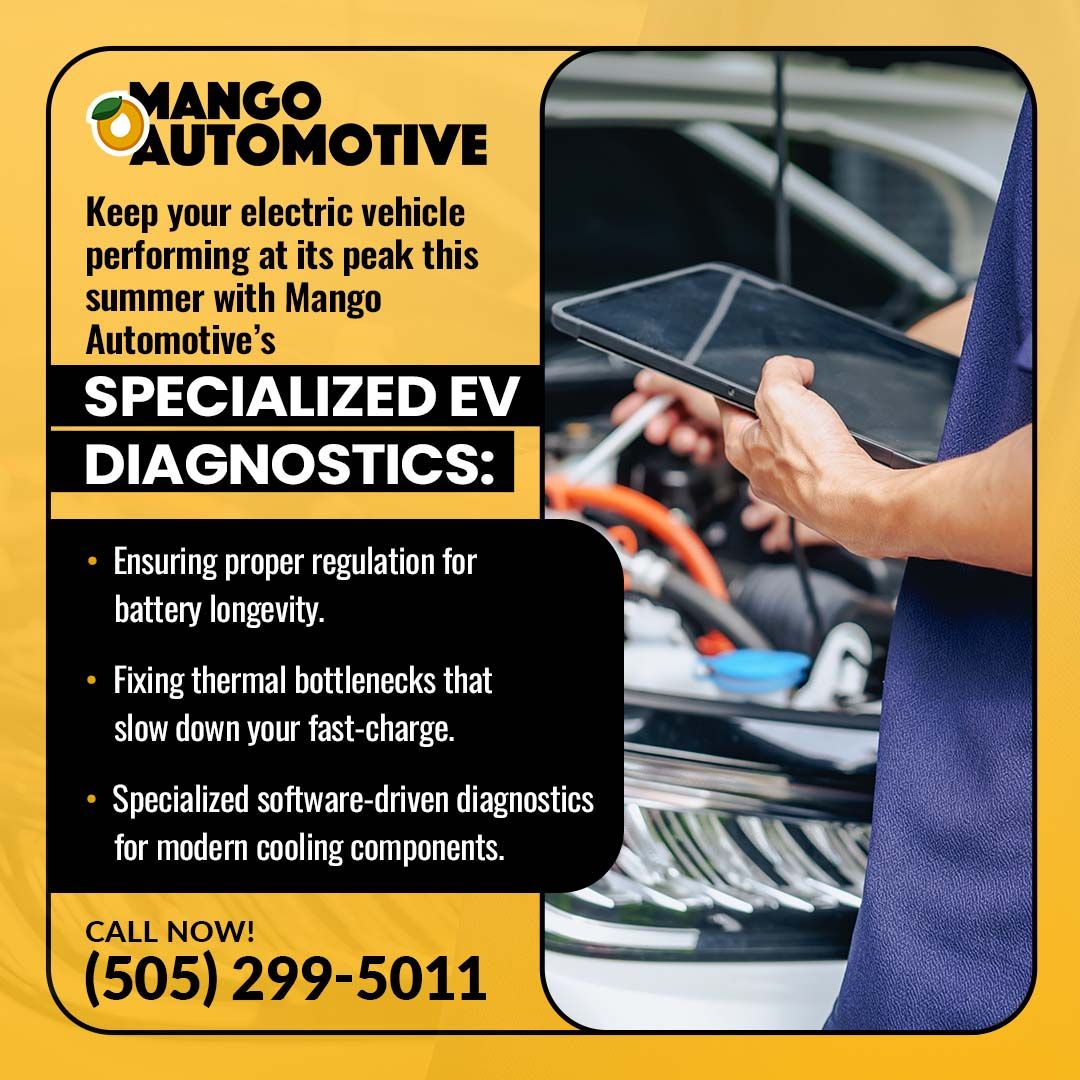
The BMS and the thermal management system work together to regulate battery temperatures. Outdated BMS software may not manage cooling as efficiently as it should. Professional-grade diagnostic tools allow technicians to check firmware versions and apply manufacturer-approved updates where needed.
All of these service points require equipment and training that go beyond standard automotive tools. When it comes to EV cooling system maintenance in New Mexico's extreme climate, working with
certified mechanics in Albuquerque, like Mango Automotive, who specialize in electric vehicles, is the most reliable way to protect your battery long term.
What You Can Do Between Service Visits
Professional maintenance handles the mechanical side. These habits help protect your EV's cooling system between visits, especially through Albuquerque's peak heat months.
- Pre-condition your EV while it's plugged in. Use your EV's pre-conditioning feature before you drive. Running the cooling system while the car is still connected to power means the cabin and battery cool down before your trip without drawing from the battery itself.
- Charge during cooler hours when possible. Charging at night when temperatures drop is better for your battery. It also puts less strain on the thermal management system, since the battery isn't fighting ambient heat at the same time it's taking on a charge.
- Park in the shade whenever you can. Hot weather is harder on your battery when the car sits in direct sunlight. Covered parking, a parking structure, or even a windshield sunshade makes a measurable difference in how hot your battery pack gets while the car is parked.
- Keep your state of charge above about 20% in summer and avoid letting your EV sit at a very low charge for long. In hot weather, the battery is more vulnerable to heat‑related wear, and a low state of charge limits its ability to tolerate high temperatures without additional stress.
- Use Eco mode during hot-weather driving. Most EVs offer an efficiency mode that reduces aggressive power demand. Less energy going out means less heat generated inside the battery, which gives the cooling system an easier job on hot days.
Why Desert Conditions Make Cooling System Maintenance More Urgent
Albuquerque's climate creates challenges that go beyond just high temperatures. The city receives more than 300 sunny days per year, which means your vehicle deals with direct UV and radiant heat exposure almost year-round. The desert environment also means fine dust and debris accumulate in radiators and heat exchangers faster than in wetter climates.
When a car parks on hot asphalt on a summer afternoon, temperatures under the hood can climb well above the ambient air temperature. That kind of sustained thermal load, day after day through a long New Mexico summer, adds up. According to a
2019 study by the Society of Automotive Engineers, an EV can lose an average of 17% of its effective range when temperatures reach 95°F compared to 75°F, and that impact grows when the cooling system is not properly maintained.
A cooling system that's serviced regularly handles all of this. One that hasn't been looked at in a while is working harder than it should, and in Albuquerque's summer heat, that gap catches up quickly.
Why Professional EV Cooling Service Is Not the Same as a Basic Coolant Check
Checking the coolant in a gas car and servicing an EV thermal management system are not the same job. EV systems involve high-voltage components, software-controlled pumps, and diagnostic data that general automotive tools cannot access.
What Sets Qualified EV Service Apart
The best mechanic in The Heights for EV cooling system work is one who has the right diagnostic equipment and the training to use it. At Mango Automotive, we use professional-grade tools to inspect every part of the thermal system, including pump performance, coolant condition, heat exchanger integrity, sensor accuracy, and BMS software. Every service is followed by a full system verification to confirm everything is performing correctly.
A Shop Built Around Your Experience
At Mango Automotive, quality repair is only part of what we offer. From the moment you walk in, you will find a comfortable waiting area, refreshments, and a team that takes the time to explain what your vehicle needs and why. Our certified mechanics in Albuquerque treat every EV owner with the same level of care and transparency, whether it is a routine cooling system check or a more involved thermal diagnosis.
EVs We Service
Whether you drive a Tesla, Nissan, Chevrolet, Ford, or Hyundai, our team has the tools and training to service your EV's thermal management system correctly. If you are looking for a mechanic shop near you that understands the demands of electric vehicles in New Mexico's climate, Mango Automotive is the team to call.
Keep Your EV Running Strong Through Albuquerque Summers
Your EV's cooling system does more work in New Mexico than it would almost anywhere else. Keeping it maintained protects your battery's range, preserves your charging speeds, and extends the life of one of the most valuable components in your vehicle.
If you're searching for the best mechanic in The Heights, Albuquerque, for EV cooling system service, our team is ready to help. Call Mango Automotive at
(505) 299-5011
to schedule your inspection today.