Albuquerque Climate and Your Vehicle: What Mechanics in Eagle Ranch Want You to Know
Albuquerque's climate puts vehicles through conditions that most maintenance schedules were never built to handle. High elevation, intense summer heat, low humidity, and strong UV radiation work on your vehicle simultaneously, creating wear patterns that drivers in moderate climates rarely deal with.
At
Mango Automotive, we have been servicing vehicles in Albuquerque since 2021, and the same weather-driven problems come up repeatedly. Batteries degrade ahead of schedule. Cooling systems push past their limits in summer. Air filters clog well before standard service intervals suggest they should. If you have been searching for a
mechanic shop near you
with firsthand knowledge of Albuquerque's climate, our team has been working with local vehicles long enough to know what this environment consistently does to them.

Altitude and Its Effect on Engine Performance
Albuquerque sits at 5,312 feet above sea level. At that elevation, atmospheric pressure is lower than at sea level, which means the air entering your engine carries fewer oxygen molecules per intake cycle. The percentage of oxygen in air remains constant at 21% at all altitudes, but that 21% comes from a smaller volume of air as elevation increases, reducing the effective oxygen available.
Internal combustion engines burn fuel by mixing it with oxygen. When the air entering the engine carries fewer oxygen molecules per cycle, combustion becomes less efficient and power output drops. Naturally aspirated engines, those without a turbocharger or supercharger to force extra air in, feel this effect the most. The engine has to work harder to maintain speed under load, which generates more heat and places additional strain on components over time.
How the Engine Compensates for Thin Air
Modern vehicles use a Mass Airflow Sensor (MAF), a device that measures the volume and density of incoming air, to adjust the fuel-to-air mixture automatically. When the MAF sensor is working correctly, the engine adapts reasonably well to Albuquerque's elevation.
A dirty or failing MAF sensor removes that compensation. The engine may then run rich (too much fuel for the available air) or lean (too little fuel), both of which reduce efficiency and accelerate internal wear. If your vehicle has shown a noticeable drop in fuel economy without a clear cause, a diagnostic scan at a mechanic shop near you can identify whether a sensor issue is contributing.
Altitude Combined With Heat and Load
The altitude effect becomes more pronounced when other demands are placed on the engine simultaneously. Running the air conditioner on a 95°F day, carrying a full passenger load, or climbing a grade all require more from an engine that is already producing less than its sea-level rated output. Over time, that pattern of sustained elevated demand puts stress on components, including the cooling system, belts, and the engine itself.
Effect of Extreme Heat on Vehicle Systems
Albuquerque regularly sees summer temperatures above 95°F. Underhood temperatures during those conditions can climb far higher. That sustained heat affects multiple vehicle systems in ways that build gradually and are often not obvious until a failure occurs.
Engine Oil and Fluid Breakdown
Heat accelerates the chemical breakdown of engine oil. As oil degrades, it loses viscosity, which is its ability to maintain a protective film between moving metal components. Oil that has broken down past its useful life lubricates less effectively, which increases friction and wear inside the engine.
Coolant, transmission fluid, and brake fluid are also affected by sustained heat. Coolant that has degraded or dropped below the proper level loses its ability to draw heat away from the engine block. In Albuquerque's summer conditions, an engine running with a marginal cooling system capacity has very little tolerance for additional stress before temperatures climb into the danger zone.
Battery Degradation From Heat
Heat is the leading cause of premature battery failure, not cold weather. High temperatures cause the electrolyte fluid inside the battery to evaporate. As fluid levels drop, the internal plates corrode faster, and the battery's ability to hold and deliver a charge decreases.
A battery that might perform reliably for four to five years in a cooler climate often shows failure in two to three years under sustained heat exposure. The difficult part is that a heat-damaged battery typically shows no obvious symptoms until it fails under the full electrical load of starting the engine.
Annual battery load testing, which measures actual capacity under operating conditions rather than just resting voltage, catches degradation before it results in a no-start situation.
Rubber Components and Seals
Radiator hoses, drive belts, vacuum lines, and door seals all contain rubber compounds that break down faster under sustained heat. Dry desert air compounds the problem by removing moisture from rubber materials, causing them to harden and crack from the outside in.
A radiator hose that appears intact from the outside may be soft and degraded internally. A drive belt showing surface cracking is approaching the point where it can snap under load. Both failures are preventable with regular visual inspections by trained
auto mechanics
who know what to look for, including stiffness, cracking, swelling near clamps, and glazing on belt surfaces.
UV Radiation and Desert Dust
Wiring and Sensor Degradation From UV Exposure
Albuquerque's elevation and year-round sunshine expose vehicles to high levels of ultraviolet radiation. UV radiation degrades plastic and rubber materials throughout the vehicle, including the insulation coating on wiring harnesses and the housing on sensors and connectors.
Wiring insulation that becomes brittle can crack and cause intermittent electrical shorts. Those shorts may produce sensor fault codes, trigger warning lights, or create electrical issues that are difficult to trace without proper diagnostic equipment. Catching wiring degradation early during a visual inspection prevents it from developing into a more involved electrical repair.
Air Filter Clogging in Desert Conditions
Desert dust particles are finer than particulates common in other regions. They pass through air filtration systems faster and accumulate more quickly. The standard manufacturer recommendation for engine air filter replacement is typically every 15,000 to 30,000 miles under normal driving conditions.
In Albuquerque, particularly for vehicles driven near unpaved roads or active construction areas, that interval should be shortened. A dirty engine air filter restricts airflow to an engine already receiving less oxygen due to altitude. The combined restriction reduces power output further and increases fuel consumption. Cabin air filters clog at a similar rate, which reduces HVAC system output and interior air quality.
Checking both filters at every oil change visit takes only a few minutes and prevents the gradual performance loss that a restricted airflow causes.
Seasonal Temperature Swings
Albuquerque winters are mild compared to northern states, but the city still sees significant temperature swings between seasons. Summer highs above 95°F transition to January lows that can drop into the 20s. That range creates a different category of stress on vehicle components.
Tire Pressure and Seasonal Changes
Tire pressure drops as ambient temperature falls. The relationship is straightforward: for every 10°F drop in temperature, tire pressure decreases by approximately 1 PSI (pound per square inch).
Underinflated tires wear unevenly across the tread surface, reduce fuel efficiency, and generate excess heat during highway driving. Checking tire pressure monthly during seasonal transitions, rather than only when a warning light appears, catches this before uneven wear becomes permanent.
Brake Fluid Degradation From Temperature Swings
Albuquerque's seasonal temperature swings put repeated thermal stress on brake fluid. Each heating and cooling cycle gradually breaks down the fluid and lowers its boiling point.
When brake fluid reaches that boiling point during heavy or sustained braking, it vaporizes and creates air pockets in the brake lines. Air compresses under pressure in a way that fluid does not, which causes the brake pedal to feel soft or unresponsive. This condition is known as brake fade. A brake fluid flush on a regular schedule removes thermally degraded fluid and restores the system to full operating condition.
These are straightforward checks that a mechanic shop near you can complete quickly, giving you a clear picture of where your vehicle stands before Albuquerque's next seasonal temperature shift arrives.
Maintenance Adjustments for Albuquerque Conditions
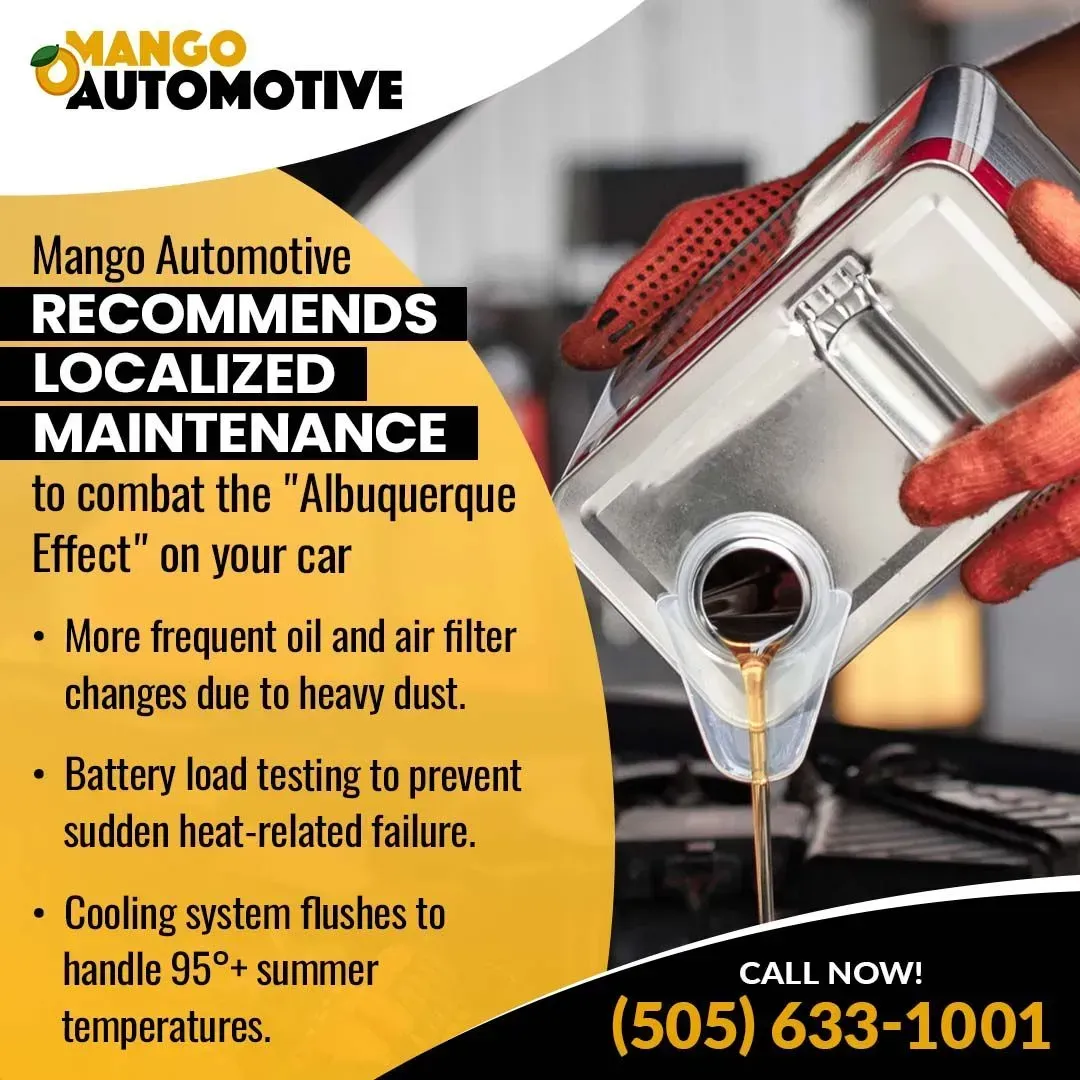
Standard manufacturer maintenance schedules reflect average driving conditions across a wide range of climates. Albuquerque's environment falls outside that average in several ways. The following adjustments reflect what auto mechanics in Albuquerque address regularly in vehicles driven locally.
Engine Oil Service Intervals
Sustained high temperatures and stop-and-go driving in summer heat qualify as severe-duty conditions under most manufacturer definitions. Severe-duty use calls for shorter service intervals than standard schedules specify. Discussing your specific driving patterns with a service technician helps establish the right interval for your vehicle.
Cooling System Inspection
The cooling system should be pressure-tested annually to check for leaks. Hoses and belts should be inspected for cracking, stiffness, and swelling at connection points. Coolant should be replaced on schedule to maintain its corrosion inhibitor effectiveness and proper freeze point.
Battery Load Testing
Battery load testing should be performed annually once the battery passes the two-year mark. A load test reveals actual storage and delivery capacity under operating conditions, which a simple voltage check cannot.
Air Filter Replacement Intervals
Engine and cabin air filters should be inspected every 10,000 miles in Albuquerque driving conditions. Replace them immediately if visual inspection shows heavy dust accumulation before that interval is reached.
Tire Pressure Monitoring
Check tire pressure monthly, including during spring and fall seasonal transitions. Reference the recommended PSI listed on the driver's door jamb sticker, not the maximum PSI printed on the tire sidewall.
Brake Fluid Service
A brake fluid flush every two years removes thermally degraded fluid and restores the braking system's ability to handle the repeated heat cycles that Albuquerque's seasonal temperature swings produce.
Mango Automotive: Mechanics in Eagle Ranch Who Know Local Conditions
Auto mechanics who work daily in Albuquerque recognize the specific wear patterns this environment produces. A shop applying a generic maintenance schedule will miss the adjustments that actually protect vehicles here.
At Mango Automotive, we have observed these patterns consistently: batteries degrading ahead of schedule, cooling systems pushed past their limits during summer, and air filters clogged well before standard service intervals. That firsthand experience shapes how we inspect and service every vehicle that comes through our bays.
Mango Automotive was built on a straightforward standard: do the work correctly the first time and communicate clearly with customers about what their vehicle actually needs. Backing that standard is a warranty built around the same level of accountability.
Our warranty covers
60 months/60,000 miles, which includes 36 months/36,000 miles of nationwide coverage and an additional 24 months/24,000 miles at our locations, applied to both parts and labor. Exclusions apply. That coverage reflects the confidence our technicians bring to every repair.

Keeping Your Vehicle Ready for Albuquerque's Conditions
The wear patterns covered above are not worst-case scenarios. These are the challenges that vehicles driven in Albuquerque face on a regular basis. Adjusting your maintenance approach to reflect local conditions is the most practical way to stay ahead of failures that a standard schedule would not catch until damage has already occurred. A vehicle serviced with Albuquerque's environment in mind holds up longer and requires fewer unplanned repairs over time.
At Mango Automotive, our
mechanics in Eagle Ranch
are ready to inspect your vehicle and identify any weather-related wear before it becomes a breakdown. Call
(505) 633-1001
to schedule your appointment. We serve drivers throughout Albuquerque and nearby areas.


Brake Fade and Its Effect on Stopping Power at High Speeds: Auto Repair Shop in Albuquerque Explains