ECU and Computer Diagnostics: How Mechanics in The Heights, Albuquerque Deliver Accurate, Targeted Repairs
Modern vehicles have become far more complex than the cars of previous generations. The systems governing engine performance, transmission behavior, braking, and emissions are no longer purely mechanical. They are managed by onboard computers that record data continuously, flag irregularities in real time, and store fault information long before a warning light ever reaches the dashboard. When something goes wrong, that recorded data becomes the most direct path to an accurate repair.
At
Mango Automotive, our
certified mechanics use professional-grade ECU and computer diagnostic equipment to read exactly what your vehicle has recorded. Rather than working through a list of possibilities, our technicians at the Heights location on Comanche Rd NE begin at the confirmed fault. That approach removes guesswork from the process, which is what makes repairs faster, more targeted, and less likely to involve parts that did not need replacing in the first place.
Diagnostic Problems That Existed Before ECUs
Before vehicle computer systems became standard, identifying the source of a performance problem meant working through every possibility manually.
A car that idles roughly could have a failing idle air control valve, a vacuum leak, a dirty throttle body, a weak fuel injector, a worn spark plug, or a faulty coolant temperature sensor. A technician had no starting point except the symptom itself. Each component had to be inspected or tested individually until the fault was found.
This process was accurate when time allowed for it. It was expensive when it required multiple shop visits. And for intermittent faults, those that appeared under specific driving conditions and disappeared on the lift, it was often inconclusive.
Modern vehicles solved this problem by building the diagnostic record directly into the vehicle.
How ECUs Create a Continuous Diagnostic Record
Every modern vehicle contains a network of dedicated onboard computers called Electronic Control Units, or ECUs. An ECU monitors a specific vehicle system, receives live sensor data, and stores a fault record any time a reading falls outside of the manufacturer's defined acceptable range.
Today's vehicles can contain as many as
150 ECUs, each assigned to a specific system. Each ECU runs its assigned system continuously while the vehicle operates. It is not waiting for a dashboard warning light to appear. It is recording data on every drive, logging patterns, and flagging readings that fall out of range.
When a technician at a
mechanic shop near you connects a professional scan tool to the vehicle, they are not guessing where to look. They are reading a record of the vehicle that has been building since the fault first occurred.
Modules That Build That Record
Several ECUs are directly relevant to the most common repair situations:
- Engine Control Module (ECM): Manages fuel delivery, ignition timing, idle control, and emissions functions. The ECM logs faults related to sensor performance, combustion events, and fuel system behavior.
- Transmission Control Module (TCM): Tracks shift timing, fluid temperature, solenoid performance, and gear engagement. When shift quality changes, the TCM's fault record reflects it before the driver notices it clearly.
- Anti-lock Brake System Module (ABS Module): Monitors the wheel speed sensor at each corner of the vehicle. A sensor that produces inconsistent signals gets flagged in the ABS module's fault log before the ABS warning light activates.
- Body Control Module (BCM): Manages electrical accessories, including lighting, power windows, keyless entry, and climate systems. Intermittent electrical faults that are difficult to replicate on demand are frequently stored here as history codes.
Each of these modules stores a Diagnostic Trouble Code (DTC), a standardized alphanumeric fault code, when it detects an out-of-range condition. That code identifies the system, the type of fault, and in many cases the specific circuit or sensor involved.
Why Accurate Diagnosis Directly Affects Repair Quality
The connection between accurate diagnosis and repair quality is direct. A repair that addresses the confirmed root cause resolves the problem. A repair that replaces the most likely suspect based on symptoms alone may not.
Here is how that plays out across common repair scenarios:
Rough Idle
A vehicle with a rough idle produces a wide range of possible causes. Without diagnostic data, a technician works through the list: spark plugs, ignition coils, fuel injectors, throttle body, idle air control valve, and vacuum lines.
With ECU data, the engine control module has already flagged which cylinder is contributing unevenly to idle, what the fuel trim values look like at idle versus cruise, and whether any sensor readings are outside of specification. The technician begins at the confirmed fault, not at the beginning of the list.
Intermittent Transmission Shudder
A transmission that shudders occasionally but performs normally during a test drive is one of the harder faults to diagnose without data. The symptom cannot be replicated on command, and a visual inspection of the transmission reveals nothing.
The TCM's stored data tells a different story. It has logged the exact conditions under which the shudder occurred: vehicle speed, fluid temperature, torque converter lock-up status, and solenoid response times. The technician reviews that record and identifies whether the fault points toward a software calibration issue, a worn solenoid, or a fluid condition problem.
ABS Warning Light With No Obvious Symptom
An ABS warning light with no corresponding change in brake feel is another situation where the physical inspection provides little direction. All four wheels spin, all four brakes respond, and nothing looks worn or damaged.
The ABS module's fault code identifies which wheel speed sensor circuit triggered the fault. Live data review during a road test confirms whether the sensor is producing a signal dropout at specific speeds. The replacement targets one sensor at one corner of the vehicle, confirmed before any part is ordered.
In all three cases, the repair becomes targeted because the diagnosis was accurate first. As a trusted
mechanic in The Heights, Albuquerque, Mango Automotive applies that same diagnostic standard to every vehicle that comes through our Comanche Rd NE location.
Beyond the Code Read: Professional Diagnostic Capability Explained
What a Retail Code Reader Misses
Many auto parts retailers provide free code reads using basic OBD-II (On-Board Diagnostics, second generation) readers. OBD-II has been the federally mandated standard for all vehicles sold in the United States since 1996. These retail tools access the OBD-II port and retrieve generic powertrain fault codes.
What they do not access is the full picture.
Generic code readers cannot read manufacturer-specific codes, live sensor data streams, or fault records stored in modules outside the engine, such as the ABS module, TCM, or BCM.
A driver who reads a P0420 code, which indicates catalytic converter efficiency below threshold, from a retail scanner knows the catalyst is flagged. They do not know whether the catalyst has genuinely failed, whether an upstream oxygen sensor is skewing the efficiency calculation, or whether an exhaust leak is affecting the reading. All three produce the same code. All three require different repairs.
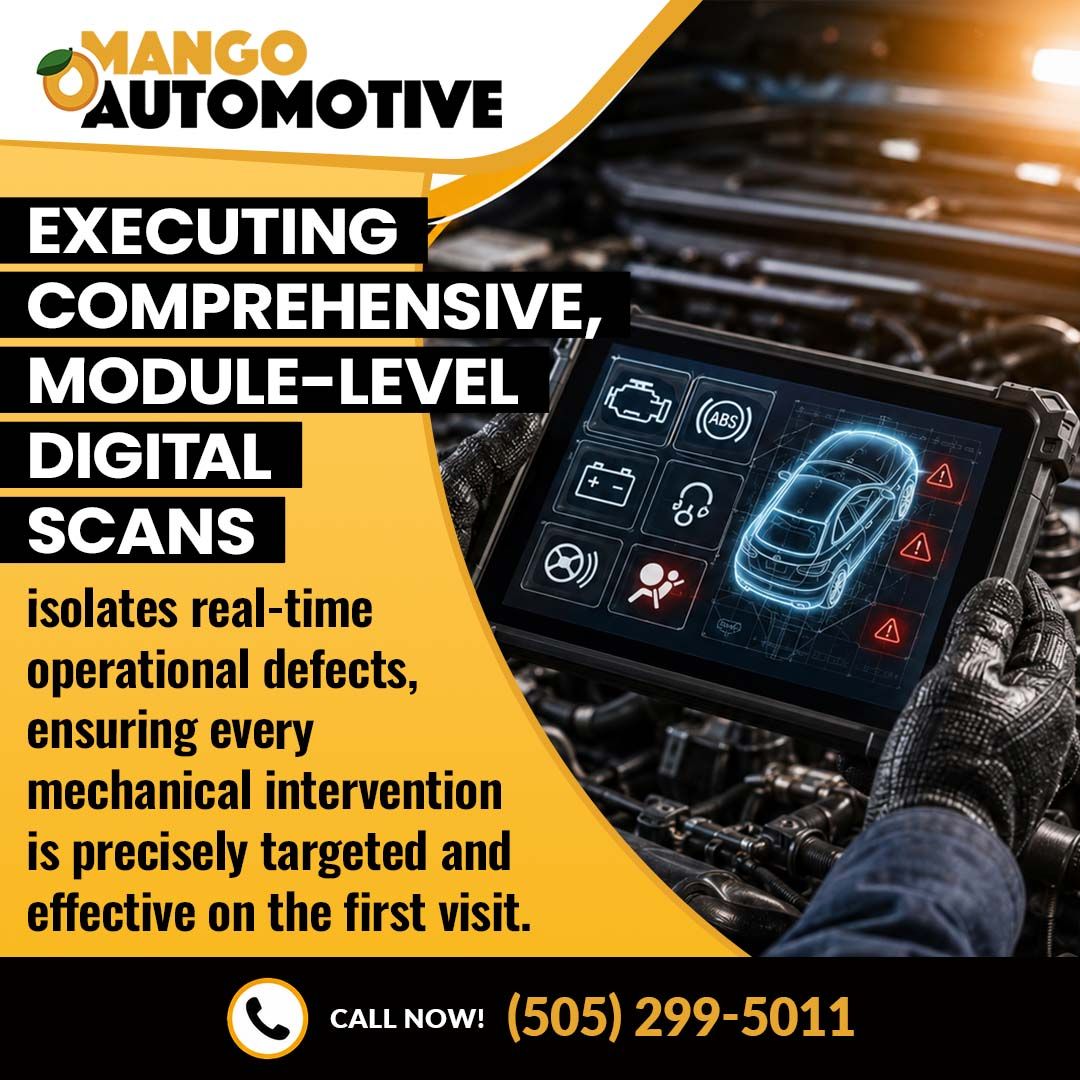
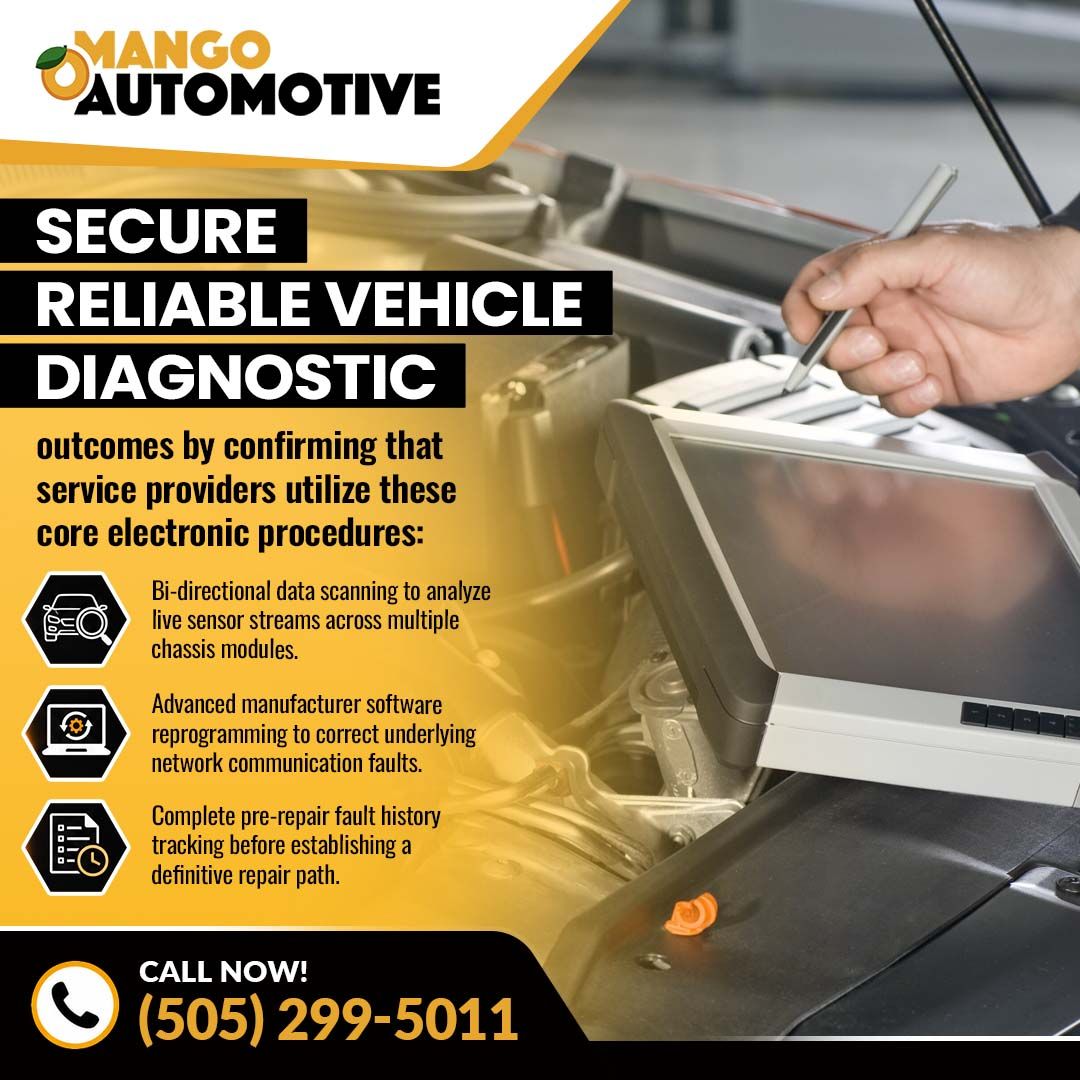
A professional scan tool used by certified mechanics at a qualified shop goes further. It accesses manufacturer-specific fault data, runs active component tests, and pulls live data from every module simultaneously. The technician sees the full fault picture, not one code in isolation.
This is the difference between a starting point and a confirmed diagnosis.
ECU Reprogramming: When the Software Is the Repair
Not every fault that stores a DTC requires a physical part replacement. Some ECU faults result from software errors, outdated calibrations, or corrupted firmware that can be corrected through reprogramming the module.
Vehicle manufacturers release software updates for ECUs on an ongoing basis. These updates address known calibration issues, improve sensor interpretation logic, and correct faults identified after the vehicle left the factory. A mechanic shop near you with manufacturer-level diagnostic access can apply these updates as part of the diagnostic process, which means some vehicles leave the shop with a confirmed repair and no parts replaced at all.
Reprogramming requires a J2534 pass-through capable scan tool and a live connection to the manufacturer's programming database. This procedure is not available through consumer-grade equipment or retail code readers.
When to Schedule a Diagnostic Scan
A diagnostic scan is the right first step any time a warning light is active, vehicle performance has changed without an identifiable cause, or the vehicle has failed a New Mexico state emissions inspection.
Additional situations that call for a scan include:
- An idle that has become rough or uneven, particularly after a cold start or at operating temperature at a stop light.
- Acceleration hesitation from a stop or when merging at highway speed, a pattern common on Albuquerque's surface streets and freeway on-ramps.
- Transmission shifts that feel delayed, clunky, or inconsistent compared to normal vehicle behavior.
- A warning light that appeared and then turned off on its own. A self-clearing code is still stored in the module as a history code and can reactivate without warning.
Bringing the vehicle to a mechanic shop near you before symptoms worsen gives the ECU fault record its best diagnostic value. The longer a fault goes unaddressed, the more likely secondary systems are to be affected.
ECU and Computer Diagnostics at Mango Automotive
Mango Automotive provides professional ECU and computer diagnostic services at our Heights location on Comanche Rd NE, serving drivers throughout Northeast Heights, near Tramway Blvd, and across Albuquerque, NM.
Our ASE-certified mechanics use professional-grade scanning equipment to access fault records from every module in the vehicle, review live sensor data, and perform active component tests before any repair is recommended. Every finding is communicated in plain language, and no repair work begins without a written explanation of what was confirmed and why it addresses the fault.
Qualifying repairs are backed by Mango Automotive’s 60-month/60,000-mile warranty: 36 months/36,000 miles nationwide, plus 24 months/24,000 miles locally. Exclusions apply, including engines, transmissions, brake pads, rotors, tires, control modules, and alignments. Ask us for complete warranty details.
For drivers across Albuquerque looking for a dependable mechanic in The Heights, Albuquerque, our Comanche Rd NE location is where accurate diagnostics and straightforward communication come standard.
Schedule a Diagnostic Appointment
Call Mango Automotive at (505) 299-5011 to schedule your appointment. Our certified mechanics serve drivers throughout Northeast Heights, Tramway Blvd, and the surrounding Albuquerque area.